Loft exhibition
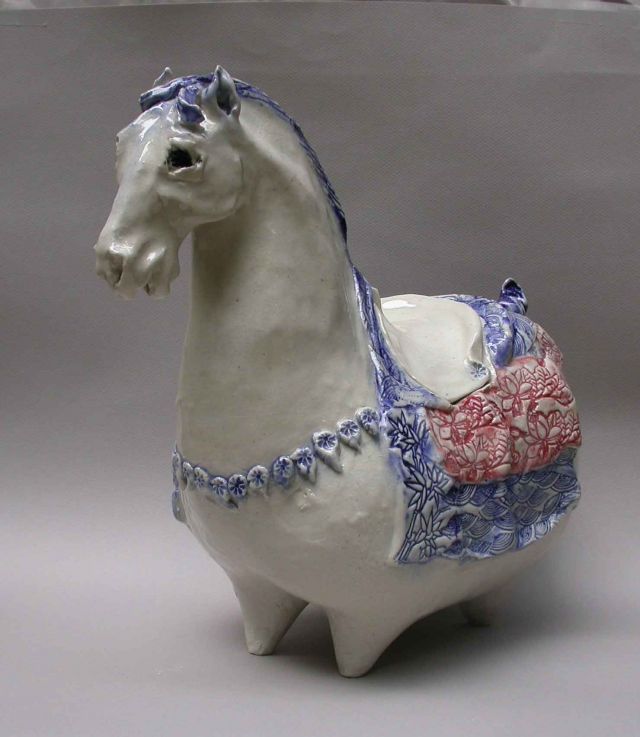
Collection Grafton Regional Gallery - Luminous Lotus Sue Fraser 2010
Floor talk Spirited Horses exhibition in The Loft Grafton Regional Gallery
I love horses and am fascinated by the part they play in our lives, particularly those of women and girls. A residency in China stimulated my interest in the historical interactions of women, horses and power in China and in particular to the ancient concubine practice, where young girls were selected for their beauty and talent to please men, much as we now deal in horse flesh.
This exhibition is based loosely on a thesis, ?The thin horse of Yangzhou?, which I read on this subject while studying at Southern Cross University. Chinese girls as young as nine years-old were trained in the arts - writing, painting, singing, music, poetry etc. to prepare them for sale as wives, servants, slaves and concubines, the latter being known as ?thin horses?. Yangzhou, an important trading town at the confluence of the Grand Canal and the Yangzi River became a major centre for the traffic of women and girls during the late Ming Dynasty. At that time a woman?s value was determined by a combination of talent, virtue and beauty, and offering a ?valuable? daughter was important to the alliance-building strategy of a well-to-do family.
The pieces in this exhibition are also influenced by the Tang Dynasty horse sculptures I have seen in China. These horses stand erect with decorative elements, some with saddles that can be removed, almost all with ears pricked and mouth open. During the Tang Dynasty there was a rise in popularity of Buddhism and an associated emancipation of women. Women rode astride, playing and fighting alongside their men.
My thin and fat horses carry modified versions of traditional Chinese decorative elements and names that rank them within the concubine hierarchy. In Chinese art, plants and animals are used as symbols; meanings change depending on combinations. Perhaps the names of the pieces in this exhibition give a clue to my intention. The rounded rumps, decorative surfaces and expressive features imply feminine aspects and possible reactions to their predicament.
I work in my studio just outside Alstonville making figurative and sculptural forms based around human horse relationships. Clay is a wonderfully plastic material that can be manipulated into almost any form and when fired is almost indestructible. These horses are fired in oxidation to 1100o. I have used a variety of clays with inclusions and local slips to create different qualities, colors and textures even though I have used similar surface treatments for each piece.
I am grateful to the National Association of the Visual Arts who supported me through a Janet Holmes à Court grant which allowed me to produce the catalogue depicting some of the work in this exhibition.
Browse
Browse By Date
- October 2025 (6)
- September 2025 (1)
- May 2025 (1)
- December 2024 (2)
- October 2024 (2)
- January 2024 (7)
- 2025 (8)
- 2024 (11)
- 2023 (1)
- 2022 (2)
- 2021 (6)
- 2020 (15)
- 2018 (1)
- 2016 (1)
- 2015 (4)
- 2014 (7)
- 2013 (5)
- 2012 (4)
- 2011 (7)
- 2010 (10)
- 2009 (2)
- 2008 (5)
- 2007 (2)